
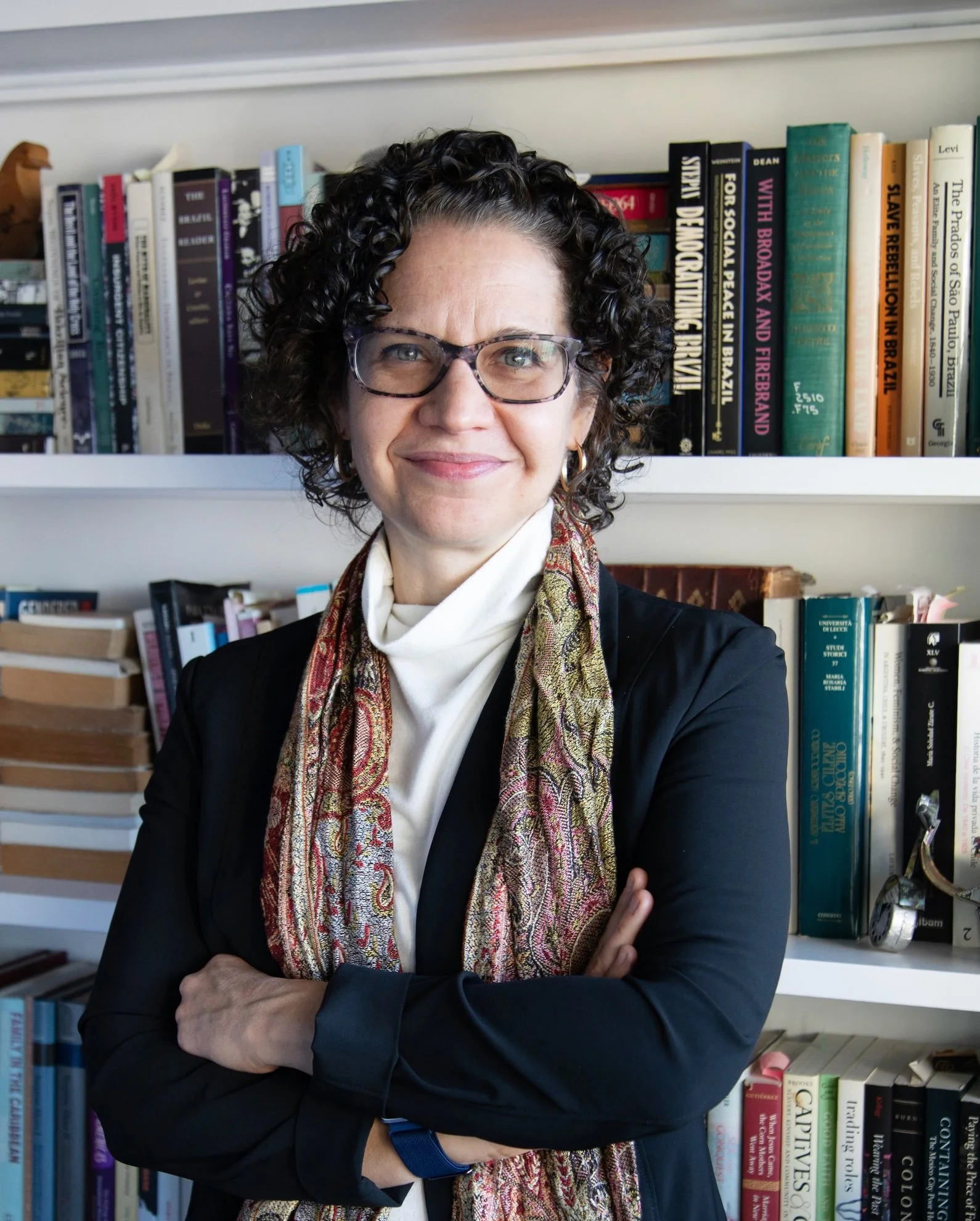
Nara B. Milanich
Author of
One Day I’ll Tell You Everything: An Orphan, a Family, and a Buried History (Beacon Press, 2028)
Paternity: The Elusive Search for the Father (Harvard University Press, 2019)
Children of Fate: Childhood, Class, and the State in Chile, 1850-1930 (Duke University Press, 2009)
Nara B. Milanich is a historian at Barnard College, Columbia University, and author of Paternity: The Elusive Quest for the Father, which was a finalist for the PROSE Award (Association of American Publishers) and has been published in Spanish (in Argentina) and Chinese. She is also the author of an award-winning academic monograph, Children of Fate: Childhood, Class, and the State in Chile, 1850-1930 and co-director, with Fanny García, of Separated: Stories of Injustice and Solidarity, an oral history project that explores the life histories of Central American parents who were separated from their children at the U.S.-Mexico border. She has a long-standing interest in how historical perspectives can inform our understanding of the present and has written for the Washington Post, NY Daily News, Foreign Affairs, and Dissent and has been a guest on Democracy Now! and MSNBC. She is the recipient of a fellowship from the Cullman Center for Scholars and Writers at the New York Public Library. She lives in New York City.

Books by Nara Milanich
One Day I’ll Tell You Everything: An Orphan, a Family, and a Buried History (Beacon Press, 2028)
One Day I’ll Tell you Everything is a brilliant work of historical investigation and imagination thattells, for the first time, the story of Antonio Cipolli, whose birth in 1945 as the result of a love affair between a married white Italian woman and an African-American soldier became a cause célèbre. A luminous and page-turning work that—a la Edmund de Waal’s The Hare with Amber Eyes and Tiya Miles’ All That She Carried—seamlessly melds research with memoir to illuminate a much larger story of World War II and its aftermath as it unravels one family’s secret history. Told through a meticulous assemblage of lyrical passages and photos, One Day I’ll Tell You Everything is a gripping story about race and belonging and family secrets that is also in many ways the story of Italy, before, during and after the war— how a country endured fascism, how it rebuilt itself in its wake, the intimate legacies of American empire, and how women and children lived these tumultuous events. It is about what it means to excavate lost histories, where the past ends and the present begins, and whether merely telling a tale can offer redress for past injustice. In excavating one forgotten love story and its devastating aftermath, it succeeds in telling a sweeping story about love and war, Italy and anti-blackness, communism and fascism, class and patriarchy, and crucially, family and belonging.
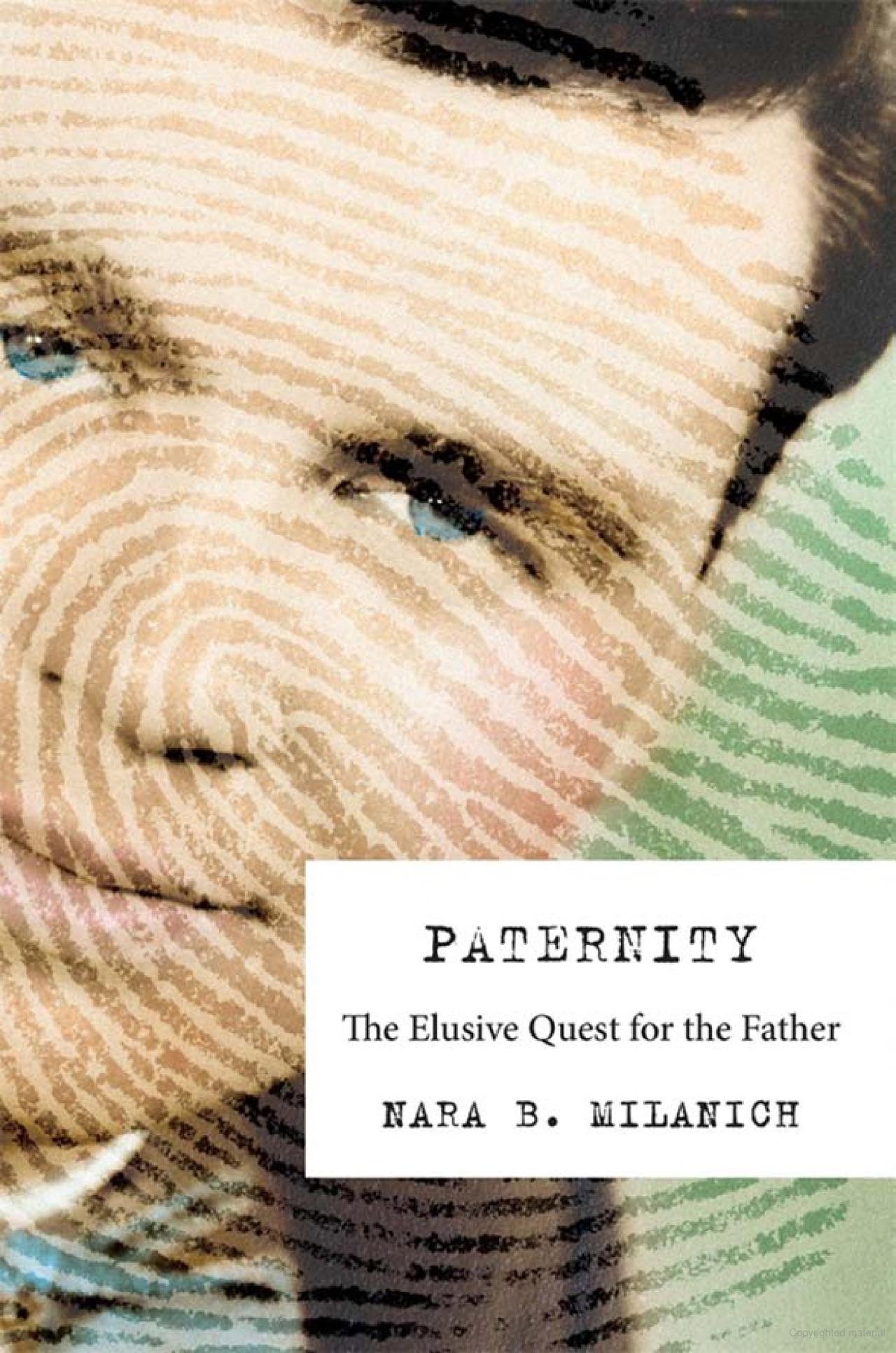
Paternity: The Elusive Search for the Father (Harvard University Press, 2019)
Finalist for the PROSE Award from the Association of American Publishers
For most of human history, the notion that paternity was uncertain appeared to be an immutable law of nature. The unknown father provided entertaining plotlines from Shakespeare to the Victorian novelists and lay at the heart of inheritance and child support disputes. But in the 1920s new scientific advances promised to solve the mystery of paternity once and for all. The stakes were high: fatherhood has always been a public relationship as well as a private one. It confers not only patrimony and legitimacy but also a name, nationality, and identity.
The new science of paternity, with methods such as blood typing, fingerprinting, and facial analysis, would bring clarity to the conundrum of fatherhood―or so it appeared. Suddenly, it would be possible to establish family relationships, expose adulterous affairs, locate errant fathers, unravel baby mix-ups, and discover one’s true race and ethnicity. Tracing the scientific quest for the father up to the present, with the advent of seemingly foolproof DNA analysis, Nara Milanich shows that the effort to establish biological truth has not ended the quest for the father. Rather, scientific certainty has revealed the fundamentally social, cultural, and political nature of paternity. As Paternity shows, in the age of modern genetics the answer to the question “Who’s your father?” remains as complicated as ever.
PRAISE
“Solidly researched and enlightening.”―Margaret Talbot, New Yorker
“Milanich follows the incremental changes, through the emergence of DNA fingerprinting in the 1980s all the way to mobile units―resembling ice-cream vans―testing DNA on the streets, all part of the billion-dollar industry of genetic knowledge.”―The Economist
“Expertly uses vignettes…to richly contextualize a history of paternity in the twentieth century…The transatlantic sweep and the dense, archivally supported detail of Milanich’s analysis is breathtaking.”―Michele Pridmore-Brown, Times Literary Supplement
“Milanich has a knack for finding a gripping story and telling it in almost novelistic or journalistic cadences. Surely, this is the definitive book on the subject of paternity testing.”―Lennard Davis, Times Higher Education
“Very readable, occasionally riveting…Milanich’s basic claim, that the search for the father reveals central aspects of modernity, proves convincing.”―Kerstin Maria Pahl, Frankfurter Allegemeine Zeitung
“A compelling history of the transnational making of twentieth-century paternity science.”―Jenna Tonn, Isis
“Milanich, a skilled storyteller, offers a fascinating social history, from the earliest times and across cultures to the rise of Big Paternity…This deeply researched and engaging exploration will likely challenge readers’ notions about paternity and shift their perspectives.”―B. K. Jackson, Severance
“Sifts through decades worth of family sagas, articles, and court records to reveal how cultural ideas about fatherhood have remained stubbornly consistent in the face of scientific progress.”―Elizabeth Svoboda, Undark
“In this rigorous and beautifully researched volume, Milanich considers the tension between social and biological definitions of fatherhood, and shows how much we still have to learn about what constitutes a father.”―Andrew Solomon, author of Far from the Tree: Parents, Children, and the Search for Identity
“Dazzling in scope and masterfully written, Milanich’s book delves beneath the quest for certainty to find what we are really looking for in paternity and why it continues to haunt us.”―Steven Mintz, author of The Prime of Life: A History of Modern Adulthood
“This splendid work shows how the development and use of paternity testing over several centuries determined individuals’ fates. For millions of people, ‘Who’s your daddy?’ was not simply an idle question, but often a matter of life or death.”―Sonya Michel, author of Children’s Interests/Mothers’ Rights: The Shaping of America’s Child Care Policy
“‘Mama’s baby, Papa’s maybe.’ DNA testing has all but destroyed the uncertainty that has attended paternity for millennia. Milanich has written a fascinating history of the ways societies have coped with anxiety about paternity, and how that anxiety has helped construct notions of fatherhood, masculinity, race, and family.”―Annette Gordon-Reed, author of The Hemingses of Monticello: An American Family
“Original, well-written, and wonderfully researched, this exciting new book provides an analysis of paternity that is rich and global in scope.”―Alexandra Minna Stern, author of Telling Genes: The Story of Genetic Counseling in America
“Paternity offers a rich, erudite, and often humorous historical analysis of how paternity testing technologies developed at the intersection of science, national governance, and popular culture.”―Rayna Rapp, author of Testing Women, Testing the Fetus: The Social Impact of Amniocentesis in America
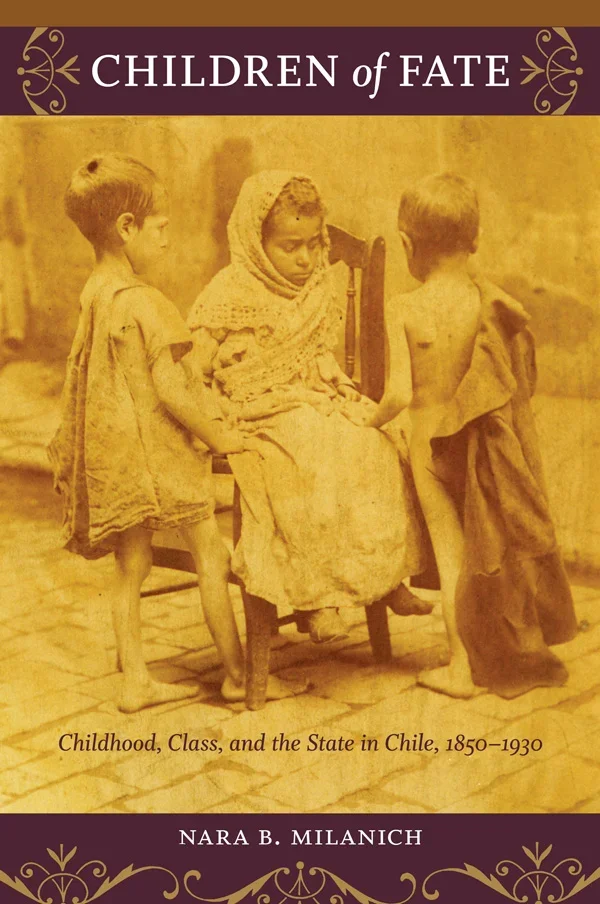
Children of Fate: Childhood, Class, and the State in Chile, 1850-1930 (Duke University Press, 2009)
Winner of the Grace Abbot Book Award
In modern Latin America, profound social inequalities have persisted despite the promise of equality. Nara B. Milanich argues that social and legal practices surrounding family and kinship have helped produce and sustain these inequalities. Tracing families both elite and plebeian in late-nineteenth- and early-twentieth-century Chile, she focuses on a group largely invisible in Latin American historiography: children. The concept of family constituted a crucial dimension of an individual’s identity and status, but also denoted a privileged set of gendered and generational dependencies that not all people could claim. Children of Fate explores such themes as paternity, illegitimacy, kinship, and child circulation over the course of eighty years of Chile’s modern history to illuminate the ways family practices and ideologies powerfully shaped the lives of individuals as well as broader social structures.
Milanich pays particular attention to family law, arguing that liberal legal reforms wrought in the 1850s, which left the paternity of illegitimate children purposely unrecorded, reinforced not only patriarchal power but also hierarchies of class. Through vivid stories culled from judicial and notarial sources and from a cache of documents found in the closet of a Santiago orphanage, she reveals how law and bureaucracy helped create an anonymous underclass bereft of kin entitlements, dependent on the charity of others, and marginalized from public bureaucracies. Milanich also challenges the recent scholarly emphasis on state formation by highlighting the enduring importance of private, informal, and extralegal relations of power within and across households. Children of Fate demonstrates how the study of children can illuminate the social organization of gender and class, liberalism, law, and state power in modern Latin America.
PRAISE
“Children of Fate will be a point of reference in the history of childhood in Latin America and beyond, not only because of its skillful interweaving of laws and forgotten lives, but also because of the eloquent balance struck between social and legal histories and private and public relations. It is accessible without being simplistic, adventuresome without leading the reader somewhere very obscure. While the historiography is specific to Chile, the book has something for most scholars of Latin American history. It can also be read alongside the most debated writings on the history of European childhood.” —Tobias Hecht, Journal of Social History
“[Children of Fate] proved to be a fascinating and well documented investigation on how civil law in Chile handled the problem of poor, marginalized, illegitimate children during an 80 year period of modern history.” —Nancy Thomas, Mil Gracias Blog
“[A] groundbreaking study of the ways in which cultural, social, and legal constructs defining family and kinship produced and propagated social hierarchy and socioeconomic inequality. . . . This book makes an important contribution to a relatively scant body of historical work on family, class, and the state in pre-1930s Chile. . . . Milanich’s study is also commendable for its effective use of a difficult and fragmented source set spread over several cities and institutions.” — Alison J. Bruey, History
“Milanich has written a fascinating and historically dramatic work that elegantly blends narrative and analysis. She places her study in a welcome comparative context that encompasses Latin America and the North Atlantic. . . . Children of Fate is an indispensable and original work that opens up a fundamental problem relating to the relationship between the family, class and the state in the liberal era. Its very originality drives forward a debate in which it will be an obligatory reference.” — Sol Serrano, Journal of Latin American Studies
“Nara B. Milanich’s engaging study of filiation, class, and the state in republican Chile represents a significant contribution to this literature. Her detailed and well-researched study will be of value to scholars of family law and childhood as well as those interested in the relationships among liberalism, patriarchy, and the reproduction of class and social hierarchy in nineteenth-century Chile.” —Christine Ehrick, American Historical Review
“Nara Milanch’s complex and engaging book, Children of Fate, analyzes the intersections between the history of childhood and the formation of the liberal state in Chile from the 1850s to 1930. . . . Milanich sets up an ambitious task for herself. . . . She accomplishes it beautifully. . . . Children of Fate is a model for future historical scholarship on childhood in Latin America.” — Eileen M. Ford H-Childhood, H-Net Reviews
“Nara Milanich has written a smart, innovative book about children in republican Chile that is sure to become a benchmark in several fields of Latin American history. Children of Fate will be of special interest to scholars of the modern period because it is among the first English-language books to identify itself with the ‘history of childhood’ genre. . . . It blazes through diverse sources such as lawsuits, wills, orphanage records, and genealogical albums to expose the gap in elite constructions between children defined as kin, who inherited status, and the rest — the kinless, rootless, and illegitimate. . . . By exploring how some children were counted as kin and some were not, Milanich makes it clear that historians’ neglect of children as a topic has impoverished our understanding of how class was made and remade in modern Latin America.” — Bianca Premo, Labor
“Nara Milanich’s Children of Fate is a fascinating study of the central role that family relations and kinship have played in Chilean society. Through a very extensive analysis of judicial cases, notarial records, and archival materials from the Casa de Huerfanos, she shows how illegitimate children and their mothers navigated a changing and complex legal world, looking for a place in a society formally and informally defined by family and class hierarchies.... Children of Fateprovides a very engaging analysis of Chilean history through the lens of children and family, redefining our understanding of this critical historical period.” — Angela Vergara, Canadian Journal of History
“This book is a major contribution to the field of Latin American childhood studies that emerged in the 1990s, as well as to studies of family history, gender, and the state. Scholarly, well-researched, and provocative, it is also well-written, engaging, and easy to read. Milanich weaves together her themes of childhood, kinship, family, class, inequality, and the state spectacularly well. Her discussion of the way in which the Chilean state reflected and upheld graduations of class and how this shaped both the life experiences of being a child and expectations about children is truly commendable.” — Jean B. Grugel, Bulletin of Latin American Research
“This richly researched and closely argued study by Nara Milanich examines the experiences of children from 1850 to 1930 to reveal how Chile’s liberal state, premised on individual equality before the law, produced inequality. . . . Most importantly, Milanich makes it clear that the history of childhood permeates metahistorical questions about social and cultural change and class and state formation and lies at the heart of the answers.” — Ann S. Blum, Hispanic American Historical Review
“With Children of Fate—a book that is thoroughly researched, insightfully argued, and beautifully written—Nara Milanich makes a compelling case for how attention to children can illuminate two issues central to the broader historiography of modern Latin America. . . . Children of Fate is a pathbreaking book that deserves a wide readership.” — Sarah C. Chambers, Journal of Family History
"Children of Fate is a social history of childhood . . . but this is not its only object of study . . . Milanich contributes to an understanding of Chilean state formation and the organization of civil society."-- Francisca Rengifo S., Revista de Historia Iberoamericana
“Children of Fate is truly original, with an extraordinary level of insight and analysis. Nara B. Milanich shows how class identity was manipulated by the liberal state in a way that maintained hierarchies, and she illustrates her arguments with rich examples gleaned from extensive archival research. A brilliant, first-rate book.” — Elizabeth Kuznesof, author of Household Economy and Urban Development: Sao Paulo, 1765 to 1836
“Children of Fate tells a thoroughly engrossing, emotionally moving story about children in Latin American history. Nara B. Milanich’s extremely powerful and original arguments about family, law, class relations, and state formation in nineteenth- and twentieth-century Latin America have major ramifications for rethinking Latin American social and labor history and will undoubtedly help reshape the agenda of future social and political history in the field.” — Heidi Tinsman, author of Partners in Conflict
“Children of Fate is a remarkable historical account of the intertwining of family law, vernacular kinship practices, and class in late-19th-century Chile.” — Clara Han, PoLAR